Press Release Hans Broek | Verweven Landschap
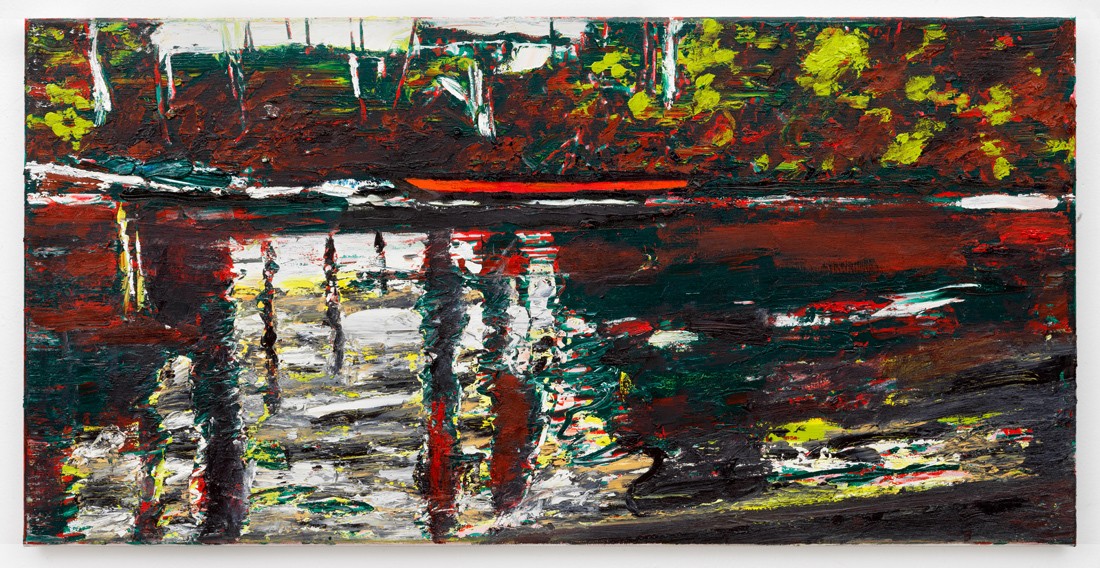
The exhibition “Interwoven Landscape” brings together landscapes and architecture from the Netherlands, Suriname, and Ghana. Hans Broek’s paintings explore how history has become embedded in physical spaces and how the legacy of slavery continues to shape today’s structures. By juxtaposing the architecture of the Dutch middle class with historical sites in Suriname and Ghana, the exhibition poses a fundamental question: What does the Netherlands have to do with slavery?
Although scholarship has convincingly demonstrated the Netherlands’ economic and social ties to the transatlantic slave trade, that history often remains invisible in everyday life. The paintings in this exhibition make that past tangible by presenting the landscape itself as a witness.
A key focus is on the homes in Hilversum, Bussum, and Kortenhoef. This region, known for its villa neighborhoods and spacious middle-class homes, began to develop as early as the 1920s and 1930s and continued to grow after 1950. The architecture, often in the style of the Delft School or early modernist bungalows, reflects the economic prosperity of the postwar period.
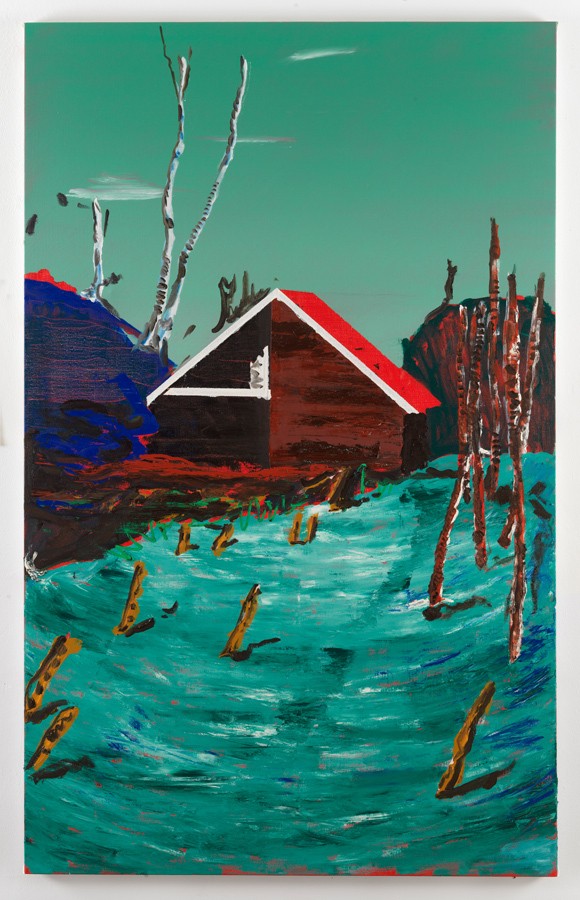
But this prosperity was inextricably linked to colonial history. The Netherlands continued to benefit from economic structures shaped by its history of slavery. These stately homes stand in contrast to the former slave forts in Ghana and the plantations and waterways of Upper Suriname. Here, the wooden canoes of the Maroons—descendants of enslaved people who escaped and founded autonomous communities—still sail. The canoes symbolize not only mobility and survival, but also resistance—a sharp contrast to the Dutch houses, which symbolize acquired stability and material prosperity.
Another key feature of the exhibition is the Oude Kerk in Amsterdam. This monumental building, located in the heart of the city, was associated with the 17th-century elite, including regents and merchants involved in the slave trade. Several influential Amsterdammers, such as leaders of the West India Company, are buried here. During Keti Koti commemorations, the Oude Kerk is recognized as a place where the legacy of the colonial past is palpable. Biblical texts, such as Genesis 9:25–27, were used at the time to justify slavery.
In addition, Herengracht 502 plays an important role in the exhibition. From 1777 onward, this building served as the headquarters of the Society of Suriname, which oversaw the administration and management of the colony of Suriname. Prior to that, the Society was located in Amsterdam’s former city hall, now known as the Paleis op de Dam. From these locations, decisions were made regarding plantations and the slave trade. Today, Herengracht 502 serves as the official residence of the mayor of Amsterdam, a jarring contrast to its past.
The paintings in this exhibition hark back to the early 1990s, a period during which Hans Broek developed his most intuitive style. After years of experimentation, he has returned to this style of painting, now enriched with a deeper layer of meaning. With “Interwoven Landscape,” the exhibition invites viewers to look at everyday places with a keener eye and to recognize the hidden traces of the past in the present.
About Hans Broek
Hans Broek made a name for himself internationally as a landscape painter in the mid-1990s. After studying in Utrecht and at the Rijksakademie in Amsterdam, he lived in Los Angeles, New York, and Senegal. In America, he created panoramic landscapes of California and his home city of Los Angeles, imbued with cinematic suspense, often at night or at dusk. Later, in New York, he also painted portraits and interiors. In 2021, he made a strong impression at Museum De Pont with the findings of his research into the Dutch history of slavery.