Press release juliette minchin | Passages
Skin That Speaks. The Ever-Changing Work of Juliette Minchin.
By Lucette ter Borg (translated from Dutch)
The most sacred place from my childhood was not in the church we went to on Sundays, nor in the modest little Marian chapel outside the village where I—just in case—would cross myself as I rode past on my bike. As a child, I found the holiest place by a forest stream, surrounded by hundred-year-old beech trees and far removed from the path where no hiker ever walked. You reached that spot by squeezing through giant rhododendrons and climbing over fallen trees.
In that spot, the banks of the stream were covered with soft, springy moss. There, the water flowed clear and murmuring, always in motion, carrying twigs and tufts of animal hair along with it. There, high up in the treetops, I heard birds echoing one another. There, for the first time, I experienced the sense of security that the forest could offer. As a child, I naturally found a word for it: magical.
The work of French artist Juliette Minchin (b. 1992) has the same effect on me. In the summer of 2021, I saw Minchin’s work for the first time at the Heilige Driehoek Biennial in Oosterhout. La Veillée au Candélou dates from just one year after the artist graduated in 2018 from the École Nationale Supérieure des Beaux Arts in Paris. Yet what a remarkable work.
The square installation La veillée au candélou glowed with a soft, flickering light: alluring, inviting. The work smelled of candle wax and was crumbling. With soft plops, pieces of warm wax fell from the metal panels onto the floor. Every morning during the exhibition, wicks were lit in the wax. Every evening they were put out. The heat of the fire melted the wax, slowly like a melting glacier, causing it to peel away from its supports in clumps. This revealed the geometrically carved panels, arranged in a closed cube formation.
La Veillée au Candélou struck me as a hortus inclusus, a sealed source that only slowly revealed its mysteries. The work was about material—of course—form, gravity, the interior of the cube. But more important was the deep sense of mystery that hung over the work. At the Sint-Paulus Abdij in Oosterhout, I thought about unchanging change, vulnerability, the power of the candle flames, and the destruction those flames caused.
And despite everything, I also thought about moving forward and building. A small but not insignificant detail: all the wax that melts from the metal structures in Minchin’s work is reused in a subsequent piece. Juliette Minchin writes to me in the run-up to the exhibition she is installing at Roof-A in Rotterdam. She has been working with wax for five years, she says. A video she sends me shows her dipping intricately crafted metal panels into wax in her studio. The metal is lowered into a bath of warm wax using a small crane and then pulled back up. The wax solidifies. The process is repeated until the textures in the panels have become thick and creamy. They have the color of white custard.
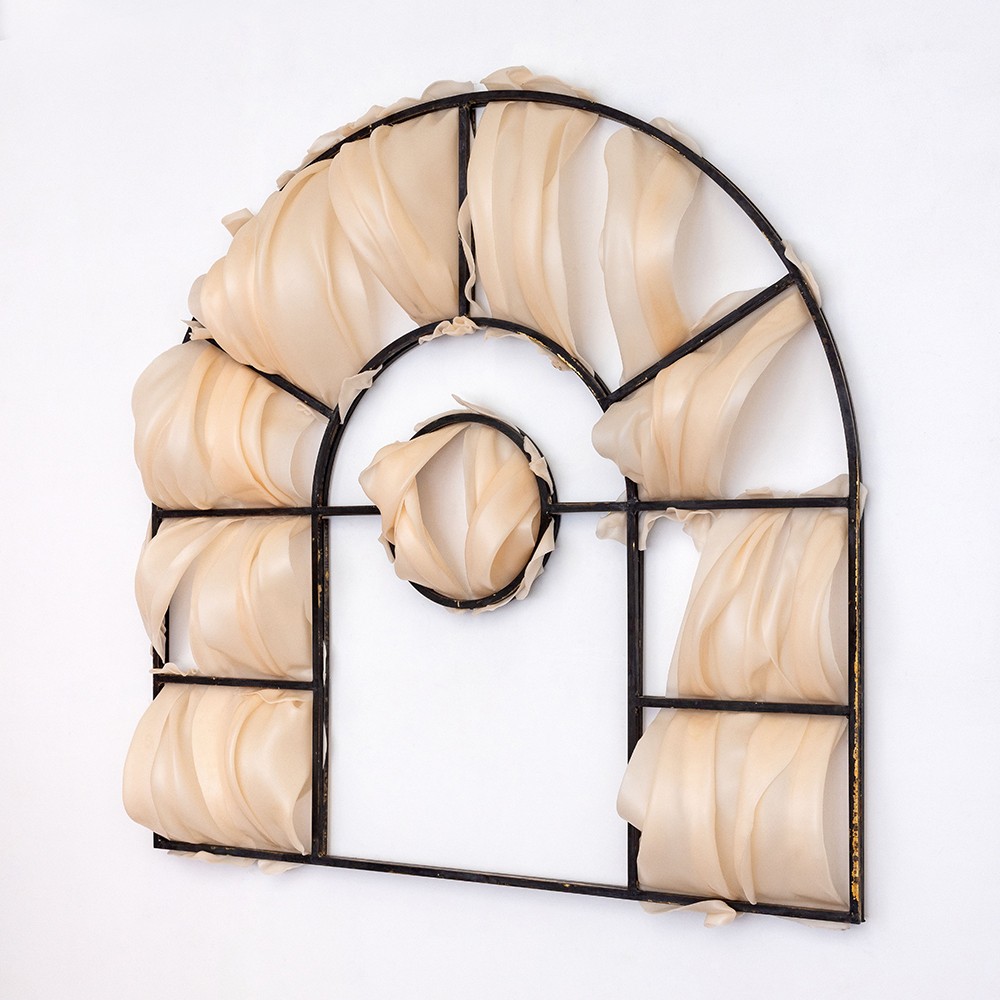
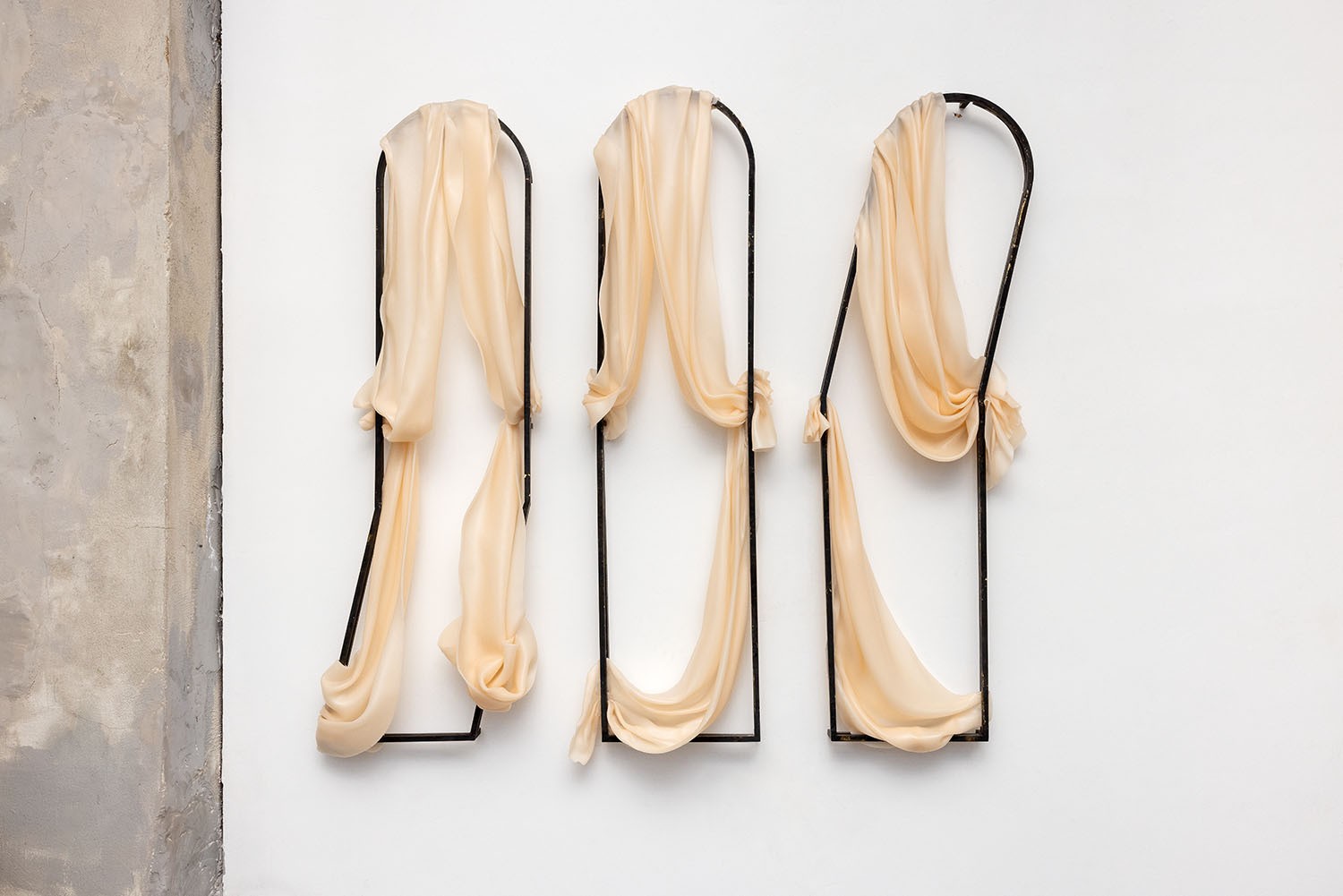
Wax has so many wonderful qualities, writes Minchin. Wax transforms; it is malleable when warm. Then she folds the wax into drapery around geometric structures. She carefully cuts off the drips. The wax solidifies on the supports. And when wax solidifies—which always carries an element of surprise—it takes on the color of our skin: sensual and inviting to the touch. The dead are embalmed with it. The oldest portraits are covered in wax. Death masks are made of wax. The transparent shroud draped around the Omphalos, the sacred “navel stone” in Delphi, Greece, which symbolized the center of the earth, reminds Minchin of wax. Wax provides protection against the cold, but also symbolic protection. Wax is part of a ritual: because you never just squeeze it out of a tube, but it takes time to mold it to your will, to let it harden and then melt again.
The exhibition “Passage” at Roof-A is “an imaginary sanctuary,” writes Minchin. That sanctuary contains twenty-four sculptures that are partially covered in wax. Each sculpture has openings through which wind can blow. One sculpture is a large panel of branches and leaves, which Minchin exhibited in 2023 at the twelfth-century Abbey of Beaulieu-en-Rouergue, a site that has been plundered many times since then. This wax-covered panel will be set alight and melt during the exhibition’s opening.
In addition to the sculptures, she is exhibiting seven drawings, two of which are enormous and will hang down from the ceiling of the gallery’s first floor. These drawings are titled Hydromancies. Hydromancy—I looked it up—is the practice of divination using water. For water—as has long been believed—possesses a predictive power. The currents in a stream, a pendulum held over a basin of water, a natural hollow formed in rocks filled with water—all of these can reveal all sorts of things. Water also has an unpredictable quality, because it goes its own way—and Minchin uses this in her drawings as well. She writes that the water “creates” the work together with her.
First, Minchin treats the paper with soot, burnt Sicilian wood, charcoal, and Armenian pigments. She then sprays the paper with water and finally dips the drawings in wax. The wax gives the drawings the appearance of sun-tanned skin. Beneath that skin, cloud-like patterns and intricate lines are visible, which, just like the lines in my hand, might just predict my future. In some drawings, an eye is visible.
Through her drawings, Minchin writes to me, she aims to capture a fragment of the cosmos. A flash of consciousness, a sense of meaning. The Hydromancies resemble prayer scrolls, ancient parchments, mandalas—but they are not. The drawings, Minchin writes, invite us to allow uncertainty into our existence, to cherish uncertainty. Just like her sculptures, the drawings are about transformation and a cyclical, rather than a linear, conception of time. The wax she uses and reuses, Minchin writes, is “like a soul passing into another soul.”
The place from my childhood, the stream with its moss-covered banks, still exists. Every now and then I return there, even though my parents have passed away and all my friends from the old village have moved to the big city. It is a place where I hold my breath, my footsteps are silent, and weight is of no consequence. The magic still hangs, almost tangible, among the trees and above the water. Unchanging, as if newly born, and always in motion.
Passages – 22 sculptures and seven drawings.