Speech Dirk van Weelden on ROOF-A/Lobke Broos
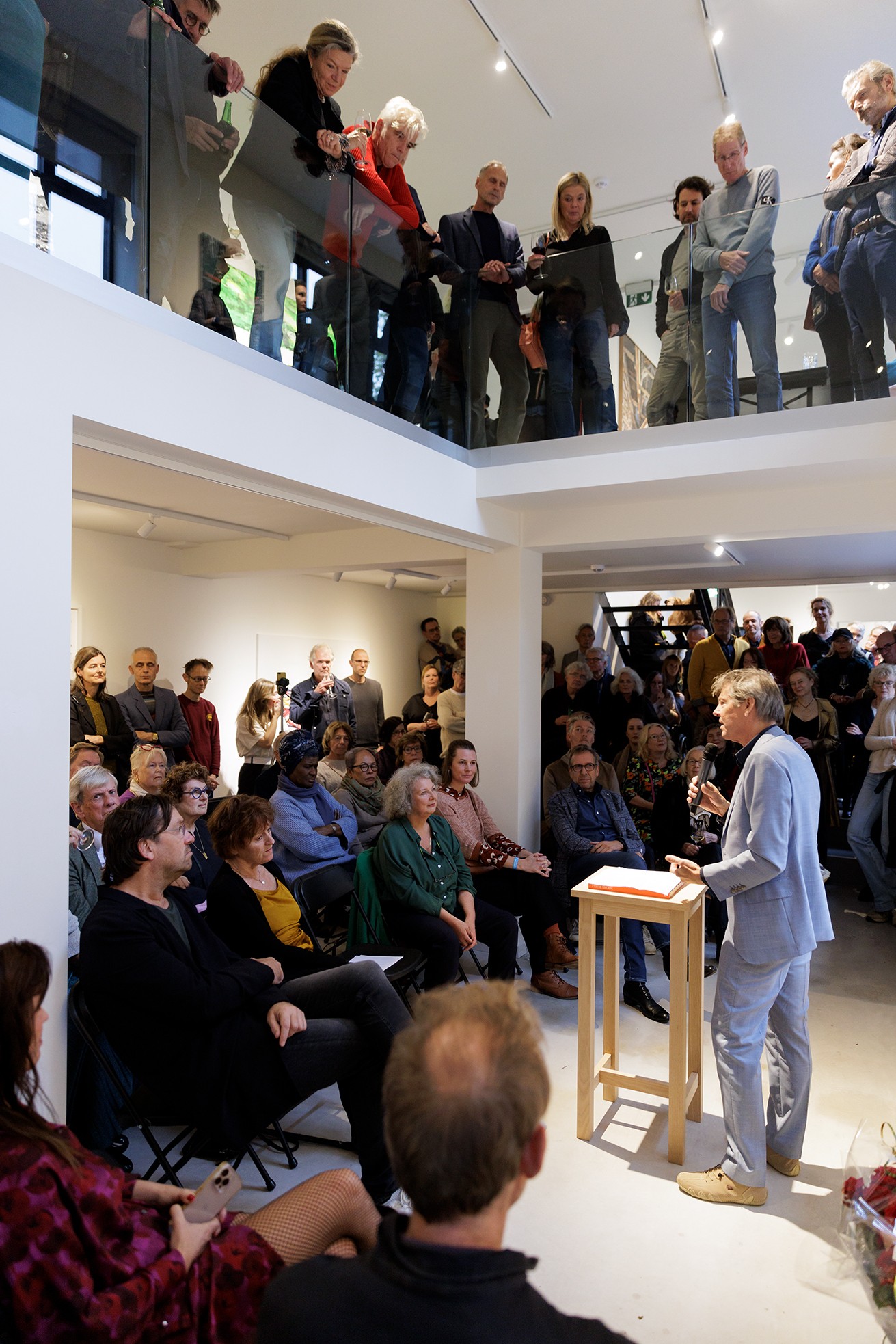
Lobke always says that what she does is a true profession and hard work. After two years of Roof-A, we can confirm that Lobke is highly skilled in her field and has worked very hard. I’d like to say a few words about what has struck me over the past two years regarding the way Lobke approaches her profession and her role. Because I believe that is the key factor in what makes Roof-A successful and exceptional.
What I think we should admire about Lobke is this: her courage to act on what she knows is just as great as her courage to act on what she doesn’t know. That’s rare. Let me explain.
Lobke knows that a venture like Roof-A can only survive on a solid business foundation, and she understands the nature of the relationships with companies, institutions, collectors, sponsors, and artists—how to establish and maintain them. She acts on that knowledge. Determinedly.
She also knows how difficult it is for young artists to gain a foothold in the art world, and that there is a huge gap between completing an art education and having an exhibition in a museum. She acts on this insight: she established the Young Talent & Experiment program, which offers emerging artists a combination of investment, coaching, and an opportunity to showcase their work. In collaboration with the AkzoNobel Art Foundation, Michelle Piergoelam’s work was selected last year and was on display here.
Lobke knows that the arts are increasingly losing ground in today’s culture and economy, and that it takes additional effort to engage people from all walks of life. She knows that our society needs the arts. That is why Lobke founded Roof-A Development, to establish partnerships with businesses, arts venues, schools, and other institutions.
Lobke knows that female artists still face historical disadvantages, as well as conventions, prejudices, stereotypes, and organizational rules that work against them. She acted on this by launching the Roof-A Award. She convinced collectors to contribute, and the first Award, presented to two women from different generations—Vera Gulikers and Hester Oerlemans—was festively awarded earlier this year at an exhibition of their work. This choice of two generations also reflects something Lobke is well aware of: it is not simply a matter of identifying a new young female star artist, but of drawing attention to a strong, continuous undercurrent of excellent work by female artists and the connections between their bodies of work.
Lobke knows that the most powerful and valuable thing art has to offer is based on a small miracle. There are works that hold our gaze, that are sometimes beautiful, but above all mysterious and strange, and that trigger something that makes us more open to realities, truths, memories, knowledge, and feelings that we usually keep at bay. We push them away, deny them, or even kick them away. Issues that make us uncomfortable. Traumas and unwelcome desires, religious, historical, or social pain points. We allow these in, thanks to the detour of the imagination, in the unique space that a work of art creates. For a moment, explanations, opinions, and judgments are suspended.
Consider the artists Lobke has exhibited in recent years: their work complicates, puts into perspective, challenges, and subverts the viewer’s perception, expectations, or judgment. In a sensory, ambiguous, and sometimes unsettling way. The work of Hans Broek, Marjan Teeuwen, and Frank van der Salm, when you let it sink in, is about me and you and all of us. Even though there isn’t a single person in sight. Lobke acts on this knowledge; she chooses art that communicates in a complex and powerful, mysterious and challenging way about issues that affect everyone.
But as I said, Lobke is just as bold in how she acts on what she doesn’t know. She realizes that Roof-A’s success doesn’t depend on how much she herself knows, or on the uniqueness of her taste or opinion. Roof-A isn’t about her, her ego, or her understanding of art. It’s about what the artworks do to people—those who look at them, talk about them with each other, collect them, and live with them. That’s a process no one ever fully understands. Something no one can control or predict. In dealing with artists, searching for and selecting work, curating an exhibition, and choosing writers for the texts, she hovers above it all, as she herself once described it, like a bird. She must steer that process in the right direction, even though it consists largely of things she does not control or know. That is why she sometimes has to wait and do nothing. She acts from the realization that the power of what she does not know and does not control is just as great as that of all the things she knows and can arrange.
When I say that she shows just as much courage in dealing with the unknown, I mean above all that she strives to be intellectually rigorous, unconventional, and principled, and then places her trust in artists and writers. She stands by her own intuition and choices. That is rare. It takes guts.
It is the combination of these two kinds of courage that makes Roof-A such a special place. There, you sense that Lobke—just like you or me, ultimately—amidst all the fancy entertainment and socializing, the bragging and flirting and bella figura, turns to art with the desire to momentarily lose her familiar contours and engage with something unknown. An experience that shakes you awake, perhaps adding something unsettling to your view of existence, the world, your body, and your youth. Despite the doubt, discomfort, and uncertainties it evokes, you can then experience beauty or comfort, or a sense of insight. But above all, a zest for life, because you feel yourself growing, healing, and living a little more fully once again.
Look at Lobke—she’s someone who wants to learn, discover, change, connect, in other words, live more fully. Not happy, naive, or innocent—no, just like all of us: a mature, flawed, scarred human being. Someone who courageously faces the truths she knows and acts on them, and without fear reaches out to the people, the works, the ideas, and the feelings about which she realizes: I don’t know.
Dirk van Weelden 2023 (translated from Dutch)