Press release Ronald Zuurmond | Hier en Nu
Ronald Zuurmond: A how-to guide
By Edo Dijksterhuis (translated from Dutch)
Take one painting by Ronald Zuurmond and hang it on the gallery wall. Recommended eye level: 1.65–1.70 meters. Stand almost uncomfortably close to it, close your eyes, and take a deep breath through your nose—two, three times, or as often as needed to feel the scent of oil paint tickle your lungs. Then slowly open your eyes again and let them wander at a leisurely pace over the landscape of fragments, indentations, and slippery patterns.
From this perspective, it is crystal clear what Zuurmond’s work is about: paint. The artist is a virtuoso of materials who has applied and scraped away the pigment time and again, modeling and smearing it. You can see the traces of his actions. You can smell how long ago he last lifted his brush and declared: yes, that’s good.
Close your eyes and take two firm steps backward before opening them once more. Suddenly, everything comes to life. Colors seem to shimmer through a dark veil. Or is the black actually trying to seep up from below into the yellow, red, and blue?
The texture, which at this distance is much less of a landscape, seems to partly reflect and partly absorb the light. Something vibrates beneath the surface of the paint. The compulsiveness of the human brain now makes itself known. We want to recognize, label, and categorize things—so we can say we understand them. Take two steps back to get a better overview. Place your feet slightly apart and bend your knees slightly so that your leg muscles are engaged yet your posture still feels relaxed. Then begin scanning. First, let your gaze move from left to right and from right to left, and slowly move from top to bottom. Then let your eyes trace figure eights across the painting, like a professional window cleaner who uses his chamois to remove every last droplet.
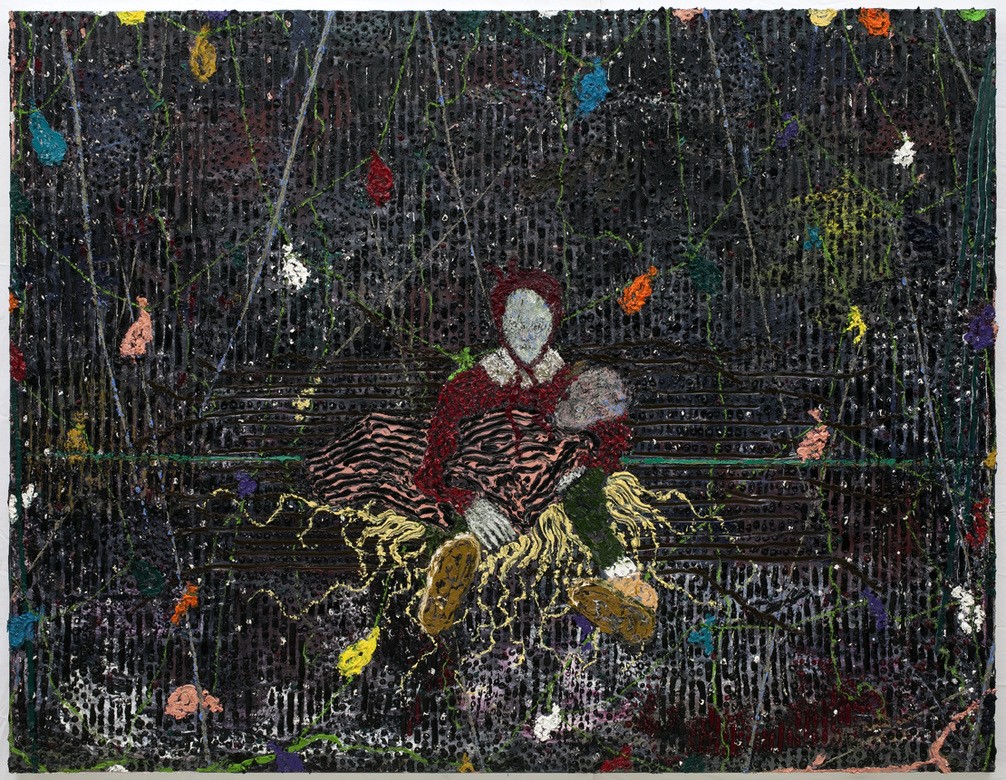
You are then handed the list of titles, search for the words associated with the work in question, and contemplate them. Meanwhile, the scanning continues as usual, though at a slightly slower pace. Through the combination of word and image, the figure in Love of My Life Waiting (2022) transforms from an anonymous woman into the artist’s beloved. The rectangles with lines in Read This (2025) become newspaper columns whose letters cry out for reading glasses.
No Party (2021) suggests that the children among the deflated balloons have little reason to cheer. And the dark colors in Wailing Wall (2021) carry added weight because of the title, while the dingy white at the top of the image evokes heads pressed against it in confessions of guilt and whispered despair. One takes a few deep breaths, turns around, and walks with measured steps to the other side of the gallery space. There, one turns around and casts a brief glance at the work. Then tilt your head back and let your eyes wander across the ceiling. At intervals of a minute or two, one briefly focuses one’s eyes on the painting.
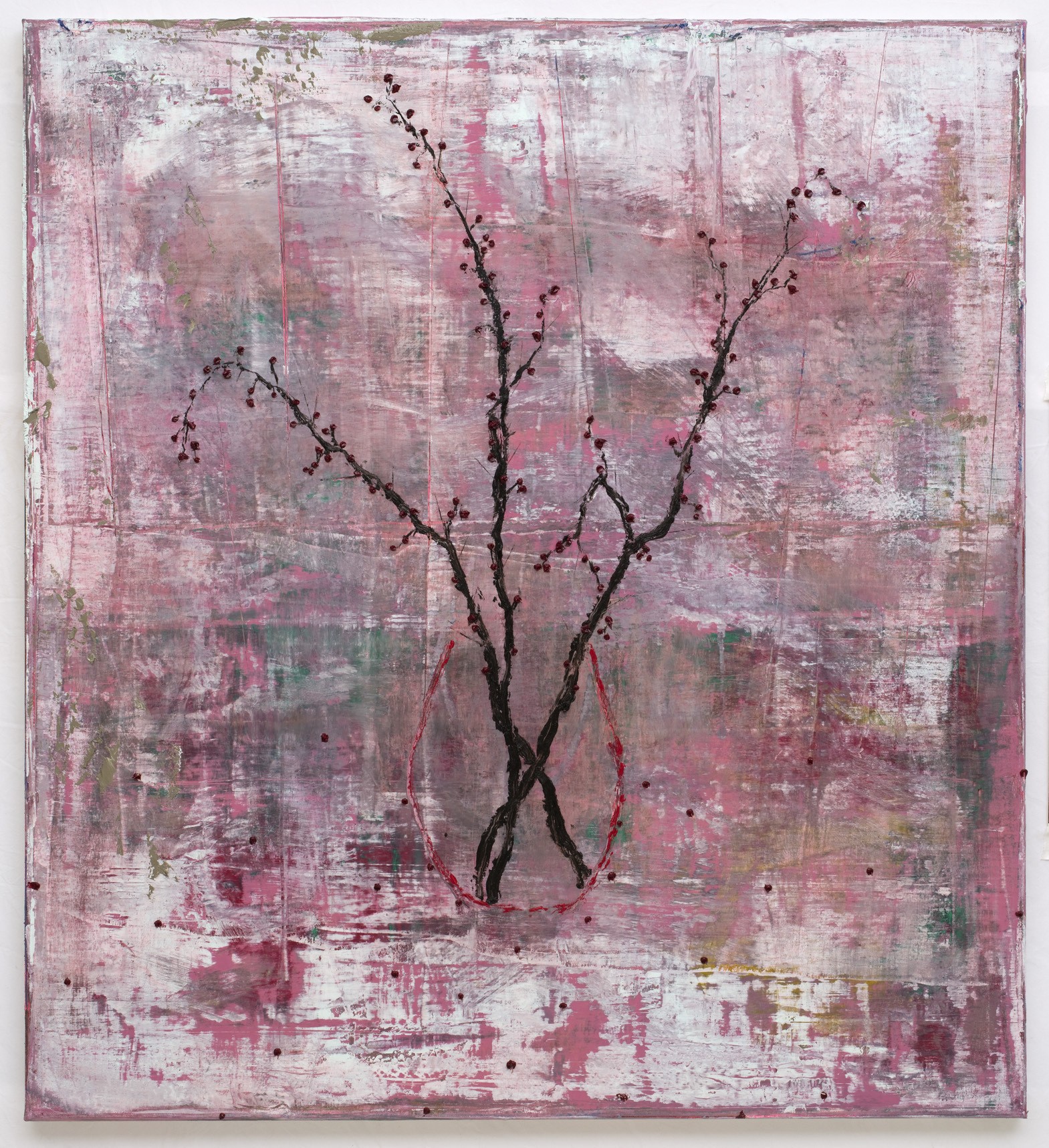
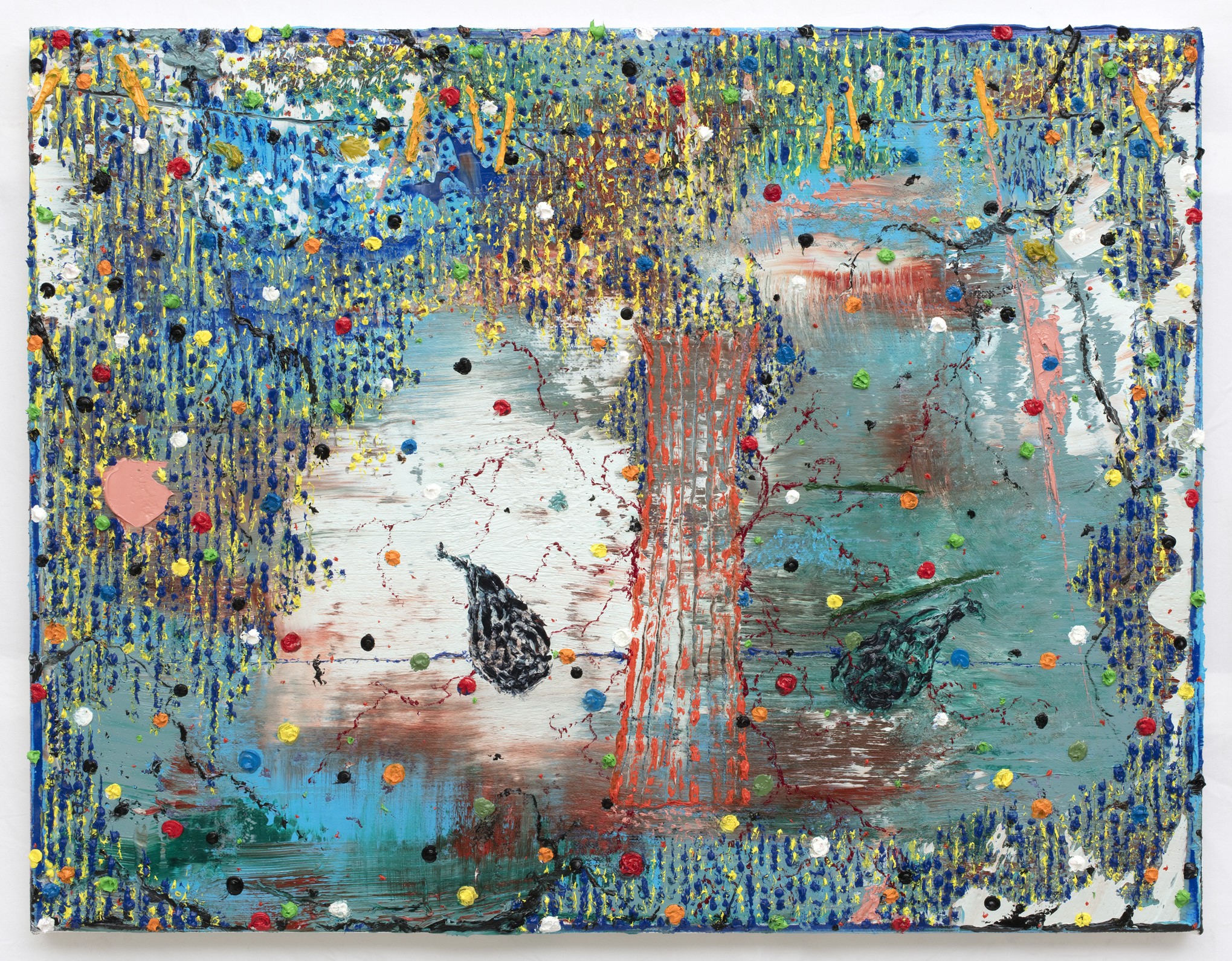
The woman who, just moments ago, was elevated to the status of a beloved figure is now becoming a portrait. The cheerful interior accessories in Vases (2025) are easily identifiable as a still life. And the children in No Party immediately bring to mind a Pietà, although a child holding a child on her lap makes for a rather bitter “genre bender.” Finally, the walls and gumballs from Gumballs (2025) play on the abstract register and evoke associations with Gerhard Richter’s rubbings, Cy Twombly’s graffiti-like scribbles, and even Damien Hirst’s dot paintings.
The next step requires careful attention. As soon as a slightly smug sense of satisfaction over the successful interpretation begins to creep in, you must decisively halt the flow of thoughts and return to the painting. Stand about an arm’s length away, in the same spot where the artist stood when he created the work. Close your eyes for a second or two and view the work as if it were your first encounter with it. See how the dots in Gumballs dance wildly yet remain in balance, how the lines they form sometimes veer off course or dissolve into one another in ways you hadn’t noticed before. Feel how vast Love of My Life Waiting is and realize how Zuurmond must have had to stand almost on his tiptoes to drape her hair like a halo around her head. How he knelt down to put on her two mismatched socks.
From this perspective, it is crystal clear that Zuurmond’s work is not about paint. Nor is it about the images created with it. These are merely a means and a starting point. They serve the act of painting itself. By standing there and working as his predecessors did hundreds—no, thousands—of years before him, Zuurmond places himself within the history of painting. Through that slow-drying paint and images that are both contemporary and timeless, he connects with deep time—the time measured in units many times greater than a human lifetime.
It is a leap toward immortality, without the pretension of writing history. It is “here and now,” being in the moment, knowing that every moment in the past and future is a “here and now.” That is the motivation that forges all these works—which at first glance seem so diverse—into a unified whole. But ask the artist about the essence of his style, and he quotes Philip Guston: “You know, comments about style always seem strange to me – ‘why do you work in this style, or in that style’ – as if you had a choice in the matter... What you’re doing is trying to stay alive and continue and not die.”
One hears this and takes two steps back to put this relativization into perspective. And one makes up one’s own mind about it.