Press release Hester Oerlemans | Hurry Slowly
(Translated from Dutch)
They look festive, the large pieces of fabric hanging across the streets of Aleppo. However, the awnings, sheets, and curtains serve a macabre purpose. They are meant to block the view of snipers hiding in the abandoned houses of the largely destroyed city. Thanks to these gently swaying fabrics, residents can quickly cross the street without coming into the line of fire. What looks like decoration—a cheerful splash of color in a war zone as gray as dust—offers meager protection against ruthless violence. The bittersweet beauty of the cloths is captured in a photo essay in Time. [1]
It were these photographs that inspired Hester Oerlemans to create a six-part series of paintings collectively titled Sniper Curtains (2019–2021). The composition is reduced to a few lines that outline the contours and folds of the curtains, sometimes in black, mostly in bright shades of blue, yellow, green, or orange. The result is a simple, powerful image with the impact of an icon. The lines are like those in cartoons: fluid, efficient, expressive, impactful. There is something paradoxical about the fact that the hanging fabric almost entirely coincides with the surface of the painting.
A curtain, intended to obstruct the view, becomes a painting that seeks to reveal something, something we have not seen before: the unexpected proximity of festive decorations and terror. Oerlemans does not paint with a brush but with stencils and a spray can. She makes the stencils out of paper, cutting out the lines of the image. To prevent the paper stencil from falling apart, she reinforces it by pasting sheer fabric onto it (in some sprayed areas, the fabric is still recognizable). Oerlemans’ self-invented, somewhat laborious way of painting gives her work a strongly graphic character with high visual impact. Her painting style borders on graffiti.
The drawings in Sniper Curtains were also created using a stencil, which was temporarily fixed to the paper for convenience—traces of glue are sometimes still visible. In some drawings, pieces of gauze or perforated sheet metal were used as stencils. The drawings appear direct, unadorned, and fresh; they candidly reveal the traces of their creation. The key to their energetic effectiveness lies in the line work, particularly that inimitable balance between precision and nonchalance, between spontaneity and perfection. It is this elusive quality that Oerlemans seeks to translate into larger-scale paintings.
Before Oerlemans began her studies at the art academy, she completed a graphic design program, making her familiar with printing techniques. Using screen printing, she has created numerous posters for artist-run initiatives such as Oceaan in Arnhem, which she founded herself, and its successor, Ozean, in her current place of residence, Berlin. The stencil is the servant of repetition. Yet the repeated use of the same stencils does not lead to monotonous repetition. Each of Oerlemans’ drawings and paintings is unique, always just a tad different.
Although the various versions of the Sniper Curtains are similar, there has been something of an evolution. Working in the studio, the artist gradually tends toward further reduction, less detail, and greater clarity. “By working in series,” the artist says, “you realize that, as a painter, you can get by with less and less.” [2] It is no coincidence that Henri Matisse is one of her heroes. Among the images that fascinate Oerlemans are not only the curtains of Aleppo but also the daily news photos of migrants, refugees, and so-called status holders in asylum centers—a sensitive topic in Dutch and international politics. Using stencils, Oerlemans created drawings and paintings of sports halls filled with cots, with not a single person in sight.
Next to the beds, she painted the names of those spending the night at these temporary shelters: Ibtisam, Raafat, Zahed Hehly—Arabic names that a Dutch tongue struggles to pronounce. In this way, Oerlemans restores the refugees’ individual identities, which are all too often stripped away by the system (What’s Your Name, 2017). The installations make politics personal and the personal political; they bring abstract developments on the world stage back down to a human scale. The refugee theme is also central to several designs for a monument in the form of a colossal flip-flop, a plan that has not yet been realized (Refugee Monument, 2017).
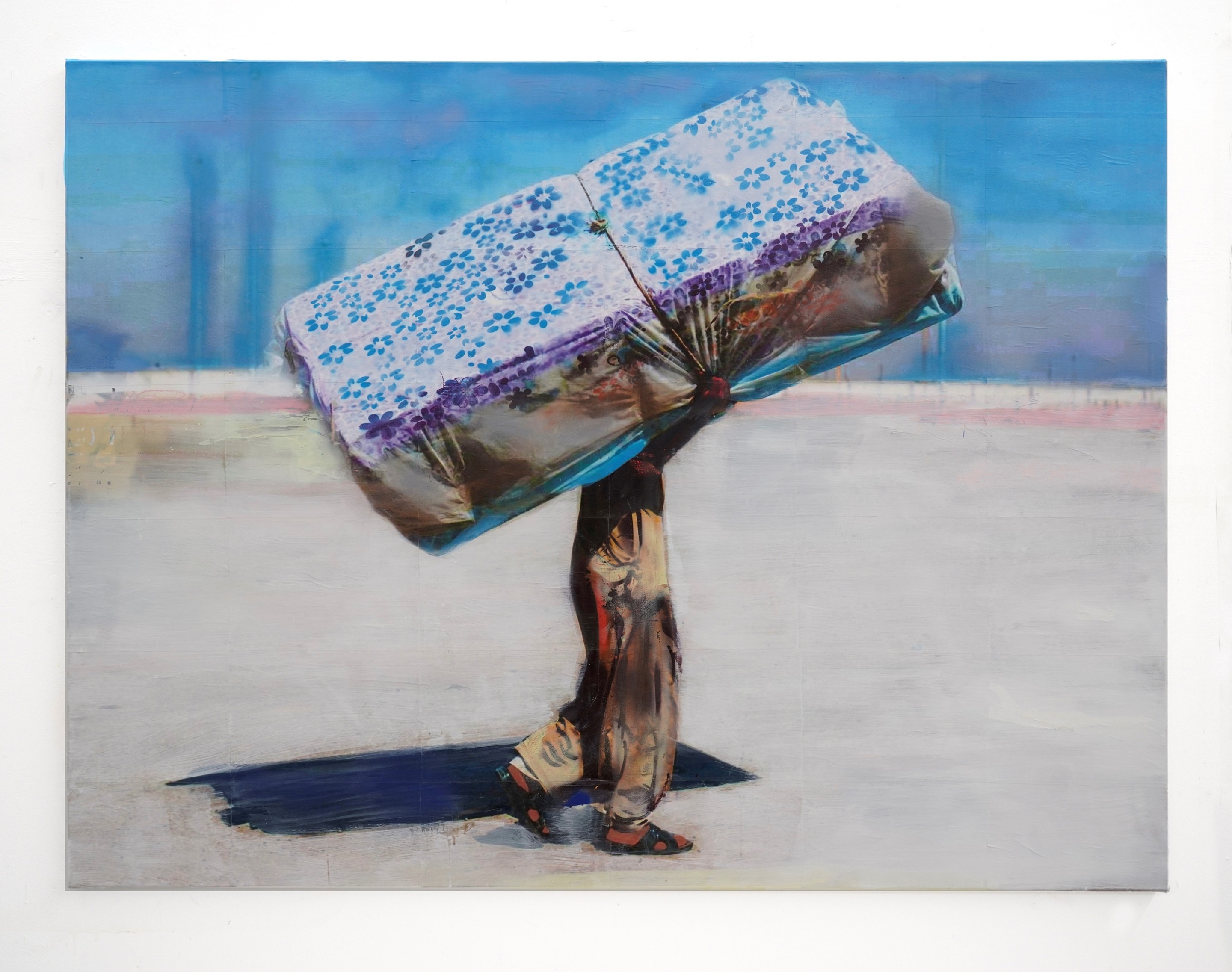
In a recent series of paintings, the artist has reversed her usual approach. Whereas she previously sought the essence of an image by translating it into a few precise lines using a stencil, she now firmly affixes laser prints of an enlarged photograph to the canvas and then paints over all the superfluous visual details. This method creates opportunities to refine an image over a longer period, to perfect it with the greatest possible nuance; something that is more difficult to achieve with stencil painting. The result is an intriguing convergence of photographic and painterly visual information.
In this group of works, there's also this tension between anonymity and visibility. Justice (2021) shows someone shielding their face with a binder to avoid being recognized. In On Hold (2022), we see a woman hiding under the mattress she carries on her head. In Kreuzberg (2022), an abandoned shopping cart with a rolled-up Persian rug takes center stage, based on a snapshot the artist took in Berlin’s immigrant neighborhood. It could be an unattended shopping cart, an impromptu move, an unexpected eviction—the true story behind the enigmatic scene is never explicitly revealed.
Opposites collide: the domestic and the nomadic, the Western and the Eastern, the familiar and the foreign. By her own account, the artist is fascinated by the sudden proximity of that which comes from afar. Oerlemans: ‘I am initially drawn to the colors and exotic patterns in the photographs, but also to the underlying issues of global migration—why people leave their homes and hearths.’ [3] Complex questions with no clear-cut answers. An asylum seekers’ center is both a place of stagnation and a refuge of hope.
The paintings do not so much anticipate the plight of migrants as they do the public’s biased perception. On the Run II (2015), for example, which depicts an African man carrying a bed on his head, is often interpreted as a portrait of a refugee, but what refugee would take their bed with them while fleeing? The cheap white plastic garden chairs found all over the world are generally considered hideous, but in Oerlemans’ intensely melancholic painting No Title (2022), they appear as the last interpreters of human dignity. Hurry slowly, the title of the exhibition, can be interpreted as an invitation to temporarily suspend any overly hasty conclusions.
The fact that possessions, housing, and status are key indicators of social identity applies not only to today’s impoverished asylum-seekers but also to the wealthy of the past. In seventeenth-century portraits of Dutch merchants and magistrates, the white collar symbolizes the wearer’s social standing. The larger the collar, the higher the owner’s prestige. What began as a stand-up collar to protect outer garments (a fashion trend imported from Spain) evolved within a few years into the so-called millstone collar: always snow-white, wide and flared, and regularly pleated and starched. The costly, fine-threaded linen appeared almost translucent, as can be clearly seen in paintings by Rembrandt and Frans Hals. Oerlemans created dozens of drawings (and a painting) of such a pleated collar, in which she meticulously reconstructs various types of pleats.
The wearer of the coveted garment, however, remains out of sight, rendering the exquisite sophistication of this display of power hollow and meaningless. Clear, straightforward images of a murky, complex reality—that is how one might characterize Oerlemans’ paintings. Her images are as catchy as a cartoon and, like the visual joke, rely on ambivalence and ambiguity. Perhaps this is best illustrated by one of her sculptures, Seat (2017), consisting of the seat of a small plastic chair by the Marko brand. Because the backrest and seat are folded together, a striking resemblance has been created to Donald Duck’s beak. In Disney’s standard repertoire, that beak is the most difficult part of the well-known cartoon character to draw. Oerlemans’ wall sculpture allows the visual motif to spring from an unexpected source with effortless flexibility.
The chair as a beak is, in essence, no different from the curtain as a makeshift shield. In simple compositions, Oerlemans depicts the fragility and strength of an existence that has been thrown off course by migration and globalization.
Text: Dominic van den Boogerd
[1] Rania Abouzeid, “The Veils of Aleppo: Photographs by Franco Pagetti,” Time, April 8, 2013.
[2] The artist in conversation with the author, Amsterdam, December 12, 2022.
[3] ibid.