Opening speech Wilma Suto | Thursday June 16, 2022
Turbulent painting and guilty architecture
By Wilma Sütö (translated from Dutch)
There is a perplexing question at the heart of Hans Broek’s (Veenendaal, b. 1965) paintings, one that holds a glimmer of hope: can art change the world? And not just make it more beautiful, but actually make it a better place? Personally, I do believe that, but the question remains perplexing, because art has no practical function. It’s not a bar of soap you can use to wash your hands, let alone end a war. It can, however, open your eyes.
Painting captures the hidden depths of existence, serving as a silent witness to all that is beautiful and ugly. Sometimes it is an ode, sometimes an indictment, which can be clearly expressed even without words. In my experience, there are quiet and loud paintings, just as there is cold and warm art, with many shades in between. Hans Broek’s work has spirit and is full of life.
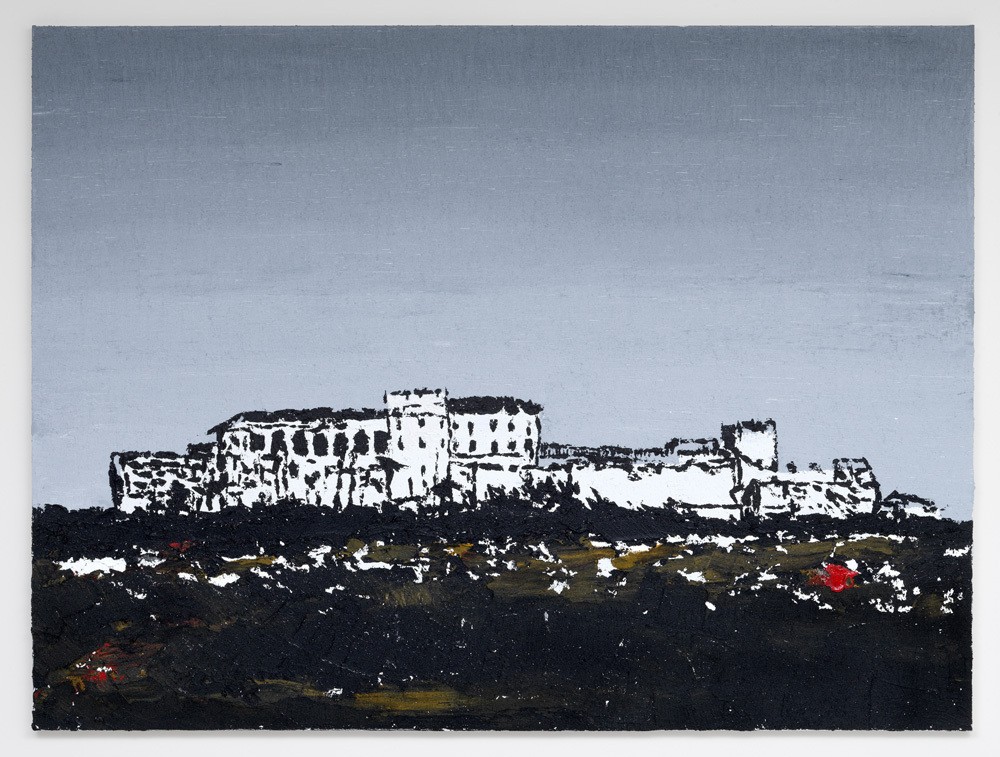
Broek paints as if he were laying bricks with palette knives dipped in tar. His paintings feature buildings that rise up before you like rocks. These are slave forts, slave cells and plantation complexes in Africa and Suriname. Many buildings from the centuries of slavery still stand. This is cruel architecture, as Broek demonstrates in paintings brimming with restrained rage. The paint has solidified but remains turbulent, with cast shadows in black and white. An example is the several-meter-tall canvas Vrouwenkerker, Fort Santo Antonio, Ghana (2022), which seems to have been scraped from reality. A stone gate with a tall iron fence blocks your view. You could look inside through the bars, but it is pitch black there.
“The psychological depth of Rembrandt and the diffuse light of Vermeer did not exist in the slave prisons, ” Broek remarks subtly when you speak with him about these paintings. “These are buildings designed functionally as structures of power and steeped in suffering. Dark and devoid of empathy. How should one describe the crimes, torture, and rapes that were the order of the day for 250 years as official Dutch government policy? Bestial? But animals do not inflict this kind of terror on one another. What might somewhat capture the essence is: devilish.”
Just as Armando painted “guilty landscapes” after World War II, Broek paints “guilty architecture.” Armando, an artist and poet, used the title “guilty landscape” for nature that looks peaceful, even idyllic, even though death and destruction had previously been sown there. The treetops around Camp Amersfoort bore witness to the suffering endured by approximately 47,000 prisoners here under German occupation. You can’t tell anything from the foliage. Broek makes the past visible in the present: he zooms in on the tangible history of forts and plantation complexes. The architectural typology of slavery was a horrifying eye-opener for him, as he explains: "A power structure from which the Nazis drew lessons."
Broek knows what he’s talking about. In recent years, he has studied the relevant literature; he has spoken with historians; he has lived and painted for months on end in Africa and the Caribbean. He brought sketches and photographs back from Senegal, Ghana, and Suriname to his studio in a former shipyard in Muiden. As a painter, he channels his bewilderment into his work. “The golden age of the seventeenth century, including the fine arts that you as a painter naturally like to emulate, have a dark side that you have to face,” he says. “Only then can you come to terms with it.”
In 2020, Museum de Pont in Tilburg presented his recent work in a retrospective that sparked a lot of discussion. There was plenty of curiosity and praise, but also plenty of judgment and prejudice. Was the entire history now supposed to atone for its sins? Were those distant forts truly hellish, or did they only seem that way through today’s politically correct lens? And, last but not least, why on earth would a white man paint (and sell!) paintings of this painful past for Black people? So many questions, bubbling with resistance to the trauma itself. History will—hopefully—never, ever be a closed book. The role of perpetrator versus victim does not—hopefully—preclude reciprocal reflection. And professional reflections, such as in art, certainly deserve a professional fee! Really, stop it, because one way or another, artists always get the short end of the stick: either as hobbyist paupers or hypocritical self-enrichers. What a shame.
His painting is a ritual and a reckoning. It is rooted in a personal motivation. Five years ago, he discovered that a family member in the seventeenth century was a member of the Amsterdam Admiralty and, in that role, was jointly responsible for the West India Company and the horrors of slavery.
He speaks thoughtfully about this past that torments him, but his paintings smolder with activism; a dynamism and concentrated emotion meant to drown out the “belle peinture.” Broek speaks of the sound of his paintings, as if they were created in a performance; the turbulence of a musical frenzy. He evokes punk; he gathers sand, dust, and grit from the ground to thicken the paint. The canvas must be allowed to be ugly, he says, but in doing so he sells himself short. Broek is a painter through and through, working at the peak of his abilities. Rather than ugly, I would say, his work is full of sound and fury, as Shakespeare described life: Life is a tale, told by an idiot, full of sound and fury.
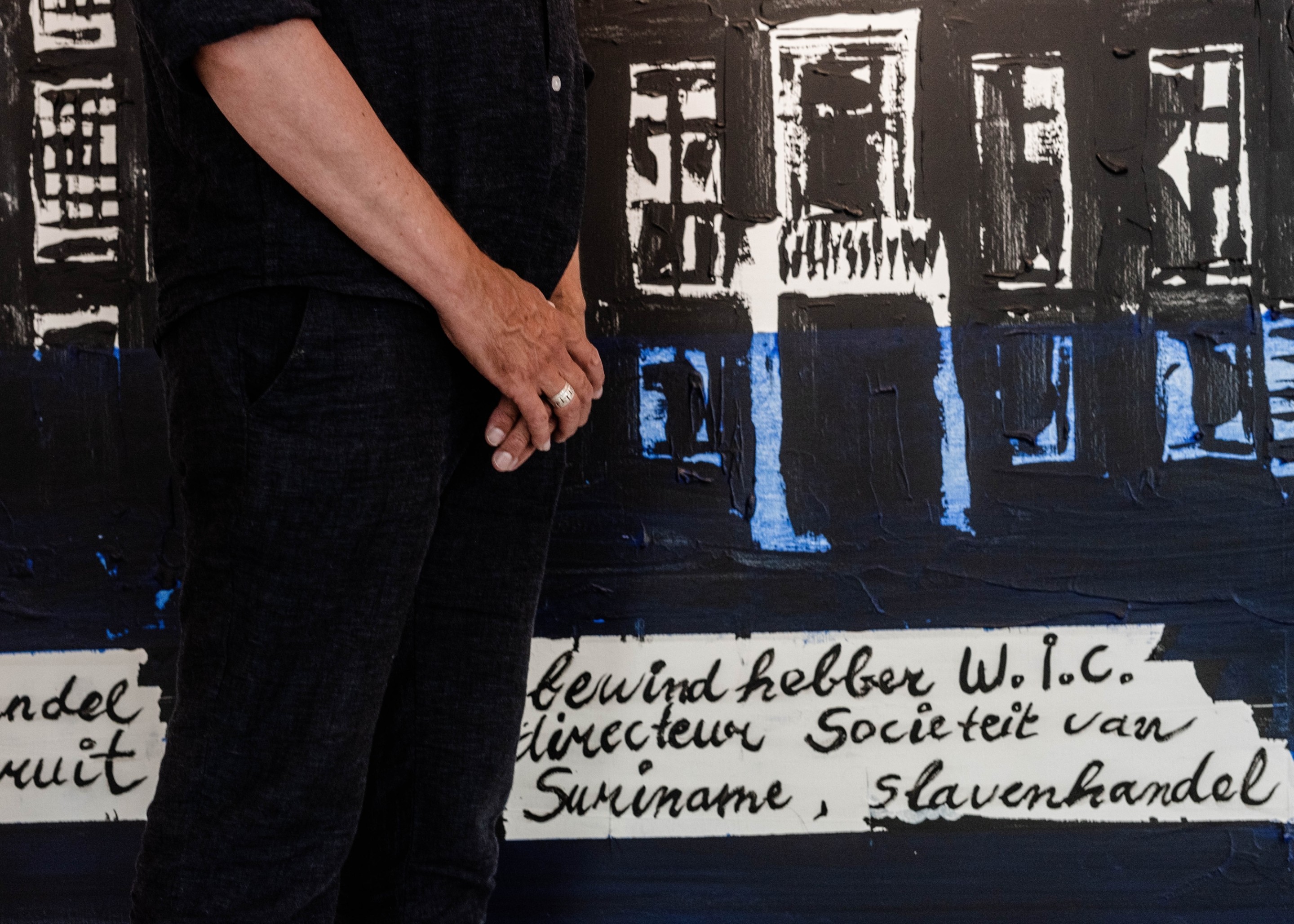
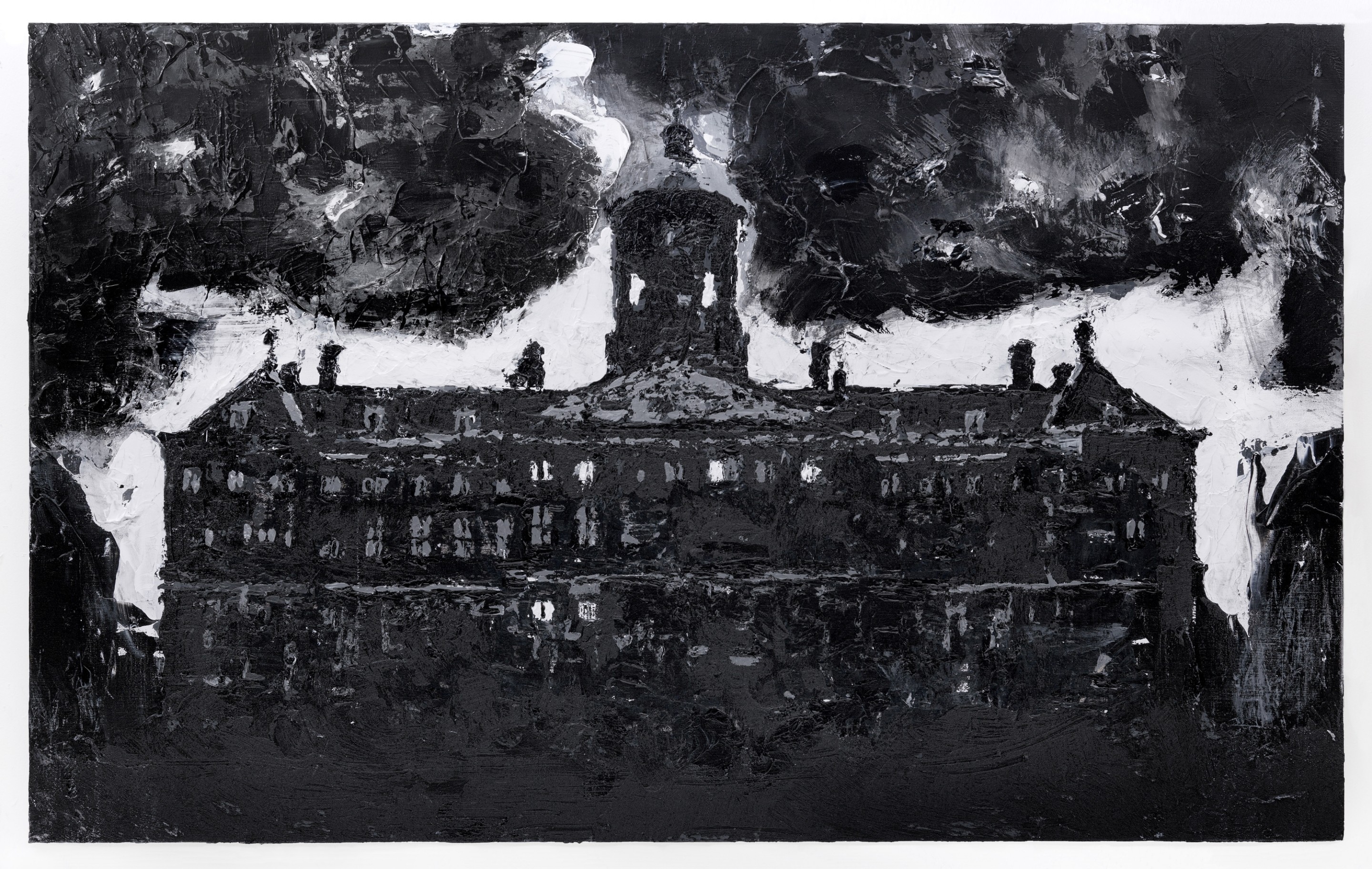
In addition to his starkly painted prisons and forts, Broek has recently begun depicting architecture built in the Netherlands during the centuries of slavery: canal-side houses, warehouses, and palaces as symbols of wealth, prosperity, status, and power. In the past, the Paleis op de Dam served as Amsterdam’s city hall, but it was also the “Sociëteit van Suriname.” This was the headquarters of the trading company that claimed ownership of the colony and administered Suriname. The title Broek has given his paintings of this iconic building is therefore: Sociëteit van Suriname. In his paintings, the Palace looms under a menacing sky, with a dark, unyielding silhouette that bears the weight of the past and stands out sharply against cloudy skies filled with ghostly visions.
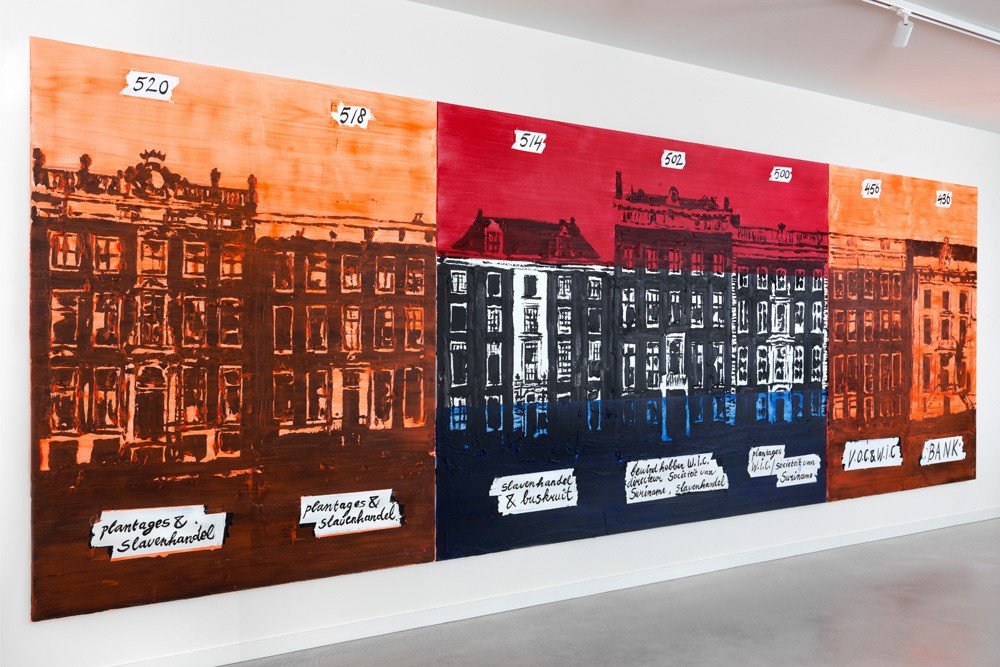
At his solo exhibition at ROOF-A in Rotterdam, titled Herengracht, and at the group exhibition Watamula: Contemporary Art on the Urge to Travel at the Dordrechts Museum, Broek is currently, in the summer of 2022, offering a first glimpse into two sides of the same story. Turning on your axis, you see plantation houses, slave forts, and dungeons juxtaposed with paintings of the Palace and a series of Amsterdam canal houses, built with profits from the WIC and the system of slavery. Mansion houses and their pious facade! The streetscape looms with its facade serving as a backdrop for the public, partly in black and white, partly in the colors of the Dutch flag and the orange of the pennant—a hellish, shrill, and bright orange, as we know it from supermarket price tags: the color of the orange lion and that of the Dutch merchant spirit.
By bringing together extremes, Broek captures the essence of our times, in which it is impossible to remain blind and deaf to the imbalance of the past that is reflected in the imbalance of today: a free, wealthy, safe world versus a world that is violent, deprived of resources, and fraught with danger. A poem is circulating on social media about the gap between those two worlds and the feelings of powerlessness that come with it. It is by the Ukrainian-American writer Ilya Kaminsky, from the collection Republic of the Deaf, and goes as follows:
We were happy during the war. And when they bombed other people’s homes, we rose up—but not enough; we protested, but not enough. I lay in my bed, and all around my bed, America collapsed: invisible house after invisible house after invisible house. I put a chair outside and watched the sun. In the sixth month/of a disastrous regime in the house of money/on the street of money in the city of money in the land of money,/our great land of money, we were (forgive us)/happy during the war.
Kaminski was recently in Rotterdam, to attend Poetry International. During the event, one of his lines of poetry was unveiled on a garbage truck in the city. For thirty years, the municipality has been spreading art throughout Rotterdam’s neighborhoods in this way, via the sanitation department, under the motto: the poem is a message. This motto also applies to the work of Hans Broek, who bridges the gap between people in different worlds with his paintings full of spellbinding powers and forces. He paints the guilty architecture as a structure of memories, reflections, and emotions.
People are sometimes said to have a heart of stone. Conversely, stones have a memory and can serve as a vessel for a human heart. Every brushstroke and every building block in the forts and dungeons, the palaces and canal-side houses in Hans Broek’s paintings is a brushstroke and building block with a human heart, in which you can hear the pounding of anger, devotion, and compassion. The painting is more than an indictment. It is also a monument to an ideal: a future in which we reverse history and the beauty of creation stands in direct opposition to destruction.
This text is the expanded version of the opening remarks for Hans Broek’s solo exhibition Herengracht at ROOF-A, written by Wilma Sütö. The exhibition Herengracht is on view at ROOF-A through September 18, 2022. At the Dordrechts Museum, works by Hans Broek are on view in the group exhibition Watamula, contemporary art on the wanderlust, through January 8, 2023. (translated from Dutch)