Press release Charlotte Schleiffert | NatureCultures
Charlotte Schleiffert | Solo exhibition
Every new exhibition by Charlotte Schleiffert (Tilburg, b. 1967) is a small celebration, and her solo show of recent work at Roof-A is no exception. Schleiffert belongs to a generation of Dutch artists who rapidly gained prominence in the early 1990s with work that was as expressive as it was disarming and socially engaged. The artist gained international renown for her exceptionally free and direct drawings and paintings, characterized by bold colors, imposing formats, and unconventional use of materials such as faux fur, silver foil, and adhesive plastic.
The infectious joy of painting radiates from the works. Gender issues play a central role in her socially and politically engaged work, as do themes such as intolerance, power, violence, oppression, poverty, and displacement. Many of her recent works explore the need to develop a less anthropocentric worldview.
The power of Schleiffert’s work lies as much in what remains undefined and implied as in what appears in her exuberant, generous depictions. This holds true for her more overtly political work as well as for her dreamlike “nature drawings.” The exhibition features several small “political” drawings, often loosely based on media images—attempts to extract pressing issues from the fleeting nature of contemporary media. The textual quotations from newspapers and magazines that characterized her earlier works have since disappeared.
Drawing on her personal involvement, Schleiffert offers razor-sharp social commentary on global issues in her work, which at times evokes the harrowing depictions of interwar artists such as George Grosz, Otto Dix, and Max Beckmann. “My anger over the abuse of power, over injustice and hypocrisy, drives me to work. I feel intense opposition to something or a tremendous sense of aggression. Then a painting must be made,” Schleiffert once stated in an interview.
For instance, the exhibition at ROOF-A features scenes of migrants on the run; the shipment of toxic Western waste to Africa; surveillance practices in the former GDR; and monkeys in a meeting, undisturbed by falling bombs—a commentary on Dutch politics driven by populism (“you might as well put a monkey there,” according to the artist). Two striking small paintings constitute ‘indictments of war in general and the war in Ukraine in particular.’ With their directness and distorted perspectives, they are on par with the war paintings Constant created in the early 1950s. As with all of Charlotte Schleiffert’s works, it is here too the small, meaningful details that enhance the expressive power: the rhythm of lines and brushstrokes; detailed and schematic sections; scratches in the wet paint; collage elements of painted human heads, cut out from other canvases.
The personal and the political are always closely intertwined in Schleiffert’s work. The artist was far ahead of her time with the large hybrid figures that played a central role in her work from the very beginning. Her protagonists embody different genders, cultural backgrounds, historical references, and even anthropomorphic and non-human forms. “Challenging types,” is how the artist describes them. As the American feminist philosopher Judith Butler would argue around the time of Schleiffert’s studies at Ateliers 63 in Haarlem (now De Ateliers; 1990–1992): identity is free and by no means fixed. Butler similarly demonstrated in works such as Gender Trouble (1990) and Bodies that Matter (1993) how gender and sexuality are not predetermined but rather the outcome of a performative game, in which roles are potentially rewritten and reconstructed anew each time.
Schleiffert’s composite creatures—which perhaps prefer to be referred to in the plural—seem to be the result of a game of this kind. “I want to create a mix of times and places. My figures aren’t always happy with their lives and dream of an alternative. They embody the longing for a different world,” Schleiffert explained in an interview. For Schleiffert, confronting grim political realities over the past decade has gone hand in hand with a search for an ideal place to live. Several works in the exhibition depict cities that, amidst an unsafe world, are protected or supported by larger-than-life female figures. A large recent canvas (“It’s quite a journey to create such an enormous painting”) shows a lying Cinderella-like figure, surrounded by monitor lizards, who seem to be watching over the vast sea behind her.
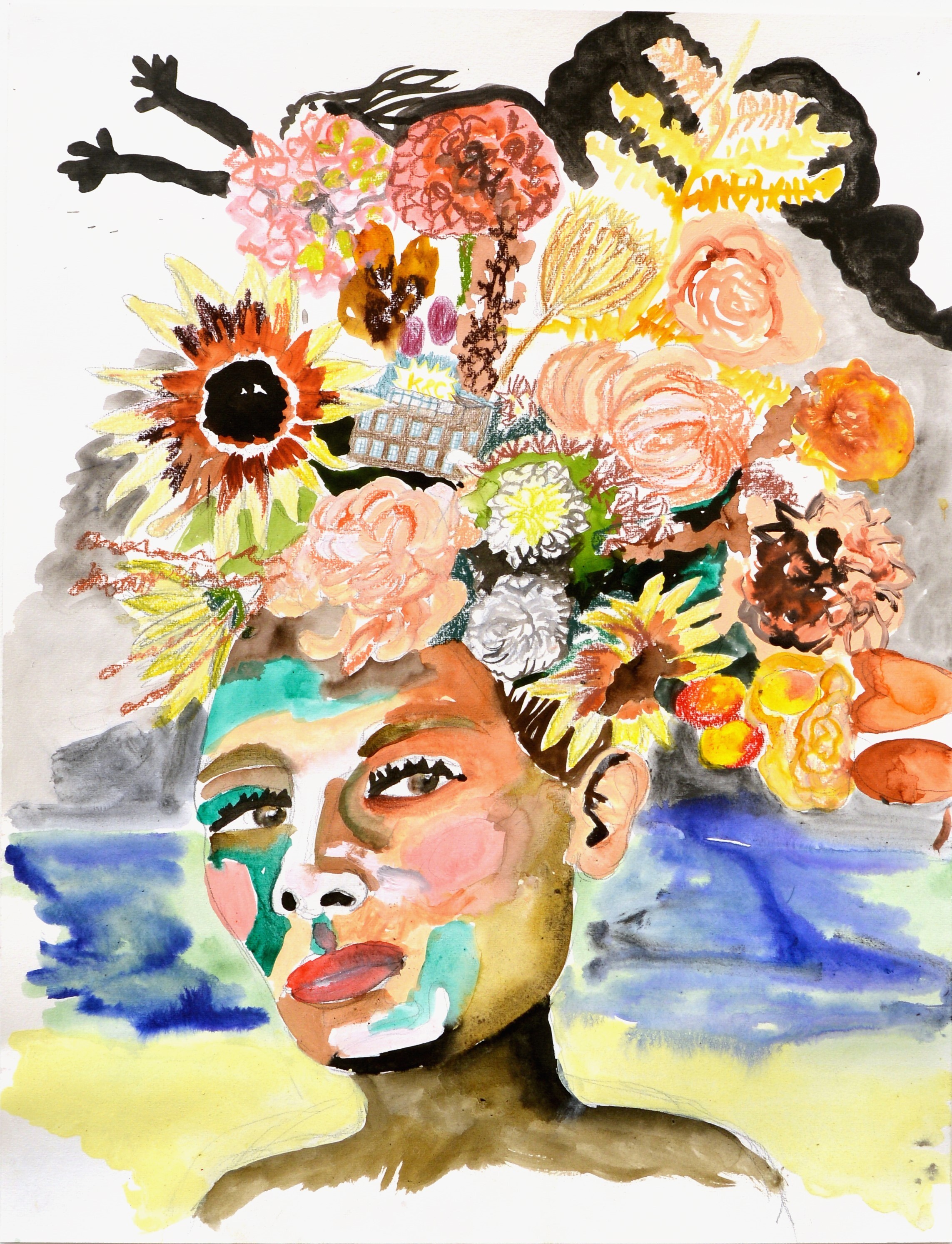
But Schleiffert’s longing for an ideal living environment is expressed above all in what she calls “nature drawings”: seemingly delicate depictions featuring floral and plant motifs, which trace their origins to the period when she was studying at De Ateliers. In 2010–2011, Schleiffert created a series of small Alice-through-the-rabbit-hole-style drawings, which were first presented as part of her exhibition "Roses and Pistols" at Museum Het Domein (2011–2012). Recently, these were followed by works on paper in various sizes.
The small drawings appear to depict nothing but natural scenes, populated by amphibians, insects, and birds, but upon closer inspection, minuscule human figures and objects can be discerned within them. In a bouquet, a biblical scene emerges of the Marys mourning over the dead body of Christ. Another work depicts a woman living inside an orchid. A pin-up girl settles down on a giant caterpillar. In a paradisiacal landscape with hibiscus, magnolias, and lupines, a couple making love can suddenly be discerned.
In these animistic drawings, which evoke the atmosphere of Erik of het klein insectenboek and Alice in Wonderland, danger is always lurking. “The images aren’t as frivolous as people sometimes think. Almost every drawing is underpinned by a concern or a problem—about war and the world we live in, or other things that weigh on my mind,” the artist explains. The protection of life and the equality of humans and nature play a central role in Schleiffert’s work. It is not difficult to view the “naturecultures” she presents in her recent works as posthumanist blueprints for a less anthropocentric world order. Who would refuse this when it presents itself so seductively and convincingly in the form of a woman in platform boots and an Oriental jacket, with the head of a pheasant?
Text: Roel Arkesteijn (translated from Dutch)